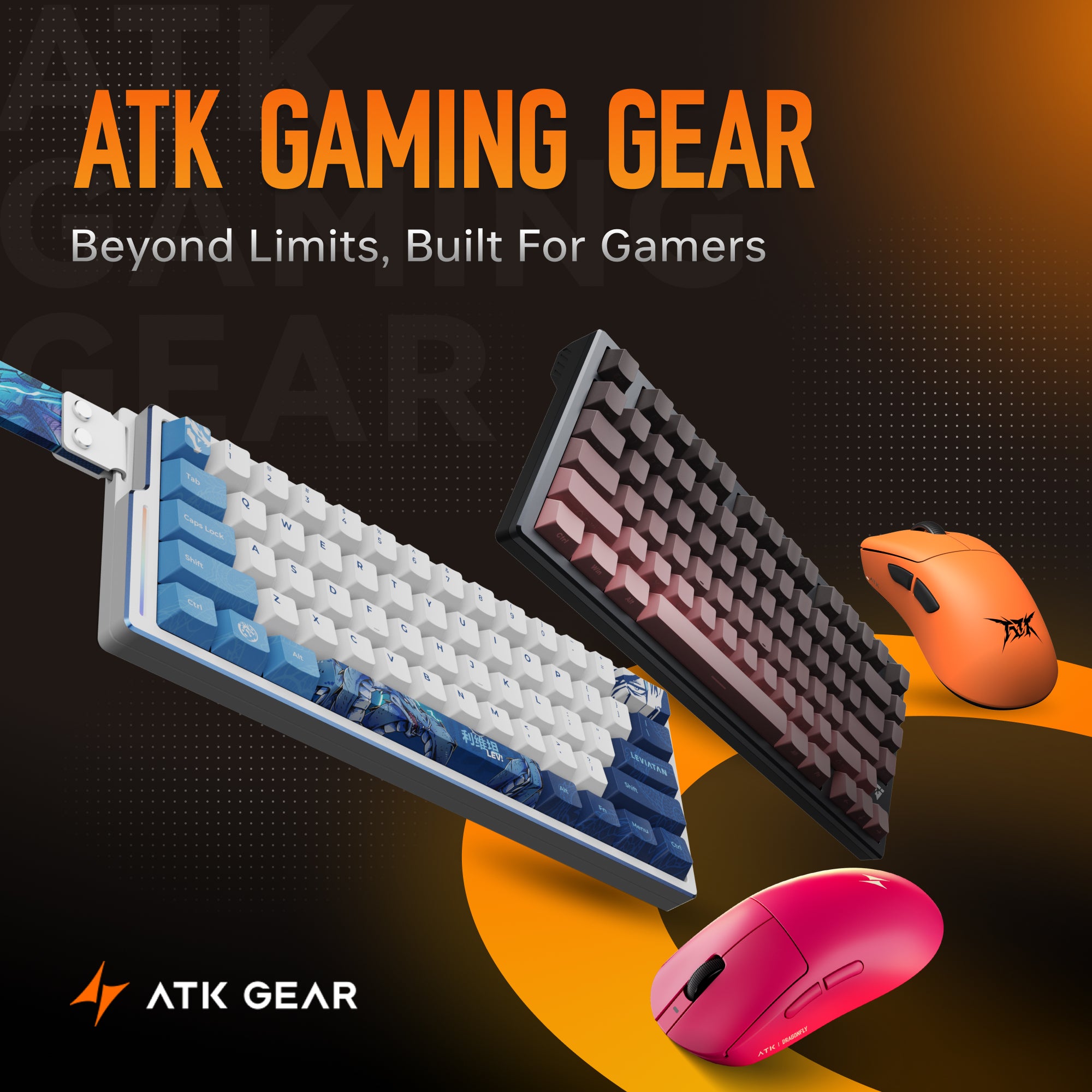


If you're trying to find the best mouse pad surface for ATK ultralight mice, start with the feel you want more than the pad brand. A light wireless mouse or wireless gaming mouse exposes surface differences more clearly, so the same gaming mouse pad can feel very different once the mouse itself is easier to move. ATK's ultralight lineup is built to move with very little effort, which makes glide speed, stopping comfort, and small-correction stability more noticeable than they are on a heavier mouse. In practice, the best fit is usually a balance between your aim style and how much control you want during fast flicks and tracking.
For a useful starting point, think of the mouse pad surface as the second half of the setup. ATK's own ZERO series positioning emphasizes low-effort handling and fast repositioning, which makes surface texture especially important for aiming consistency. If you use a best gaming mouse setup, or even a best wireless mouse for everyday play, the pad can either sharpen that feel or make it harder to control. If you want to compare options safely, focus on the surface family rather than chasing a perfect spec match.

Compare the Main Surface Types
The table below gives a simple comparison of the surface types most people evaluate for ultralight mice.
| Surface Type | Glide Feel | Control Feel | Best Fit | Watch-Outs |
|---|---|---|---|---|
| Speed cloth | Very smooth and quick | Lower natural resistance | Fast-paced aimers, low-friction preference | Can feel loose if you rely on hard stopping |
| Balanced cloth | Smooth with some texture | Medium control | Most all-around players | May not feel specialized enough if you want extremes |
| Control cloth | Slightly more drag | High stopping confidence | Players who need steady micro-adjustments | Can feel slower in repeated swipes |
| Hybrid surface | Depends on weave and finish | Usually moderate | Users who want a compromise | Feel can vary more by brand and finish |
| Hard surface | Very fast and consistent | Low to medium control depending on mouse feet | Players who want minimal resistance | Noise, wear, and sensitivity to small mistakes |
A quick way to read the table: with an ultralight mouse, faster surfaces tend to make the mouse feel even lighter and more effortless, while control-oriented surfaces make the same mouse feel more planted. That is why the best mouse pad surface for ATK ultralight mice often comes down to whether you want to amplify speed or add restraint. If you like an artisan mousepad style of smooth, specialized feel, a faster surface may appeal to you; if you prefer a more familiar cloth mouse pad, control usually comes easier.

Choose by Playstyle, Not Just Feel
If You Play Fast and Reactive
Speed-leaning surfaces usually make sense if you rely on fast target transitions, frequent resets, or broad arm movement. They reduce friction and can make the mouse feel more alive. If you already have solid stopping mechanics, a faster pad can be a good match for an ultralight mouse because it preserves that easy motion without making every movement feel heavy.
If You Value Steadier Precision
Control-leaning cloth surfaces are often easier to live with if your aim depends on calm micro-corrections, target tracking, or consistent stopping points. They can help the mouse feel less slippery, which some players prefer when the mouse itself is extremely light. For many buyers, this is where the best mouse pad surface for ATK ultralight mice begins to feel more usable in everyday play than a pure speed pad. It also tends to be the safer starting point for a wireless gaming mouse or a very light superlight mouse if you are still tuning sensitivity.
If You Want One Surface for Everything
Balanced cloth is usually the safest middle ground. It gives enough glide for quick movement while still keeping a sense of structure under the mouse feet. For most people comparing options across shooters, productivity, and mixed game genres, this is the least risky surface category. If you are scanning best mouse pads or gaming mousepads for a desk setup, balanced cloth is often the least disruptive first choice.
Scenario Matrix
| Your Priority | Better Starting Point | Why It Tends To Work |
|---|---|---|
| Fast flicks and low-effort glide | Speed cloth or hard surface | Reduces resistance and supports quick travel |
| Stable tracking and micro-adjustments | Control cloth | Adds drag and makes stopping more deliberate |
| Mixed aim styles | Balanced cloth | Keeps both movement and control reasonably even |
| Testing a very light mouse for the first time | Balanced cloth first | Easiest way to avoid overcorrecting into extremes |
The Tradeoffs to Keep in Mind
A lighter mouse does not automatically need a faster pad. In fact, pairing an ultralight mouse with an extremely fast surface can make the setup feel too sensitive if your hand is still adapting. On the other hand, going too far toward control can mute one of the main benefits of an ultralight design.
The main tradeoffs are straightforward:
- Speed vs. braking: faster surfaces feel effortless but give less natural stopping resistance.
- Consistency vs. freedom: control surfaces reward careful aim, but they can feel restrictive during rapid movement.
- Comfort vs. specialization: balanced cloth is often the easiest long-term choice, even if it is not the most exciting one.
- Wear and maintenance: hard and hybrid surfaces may behave differently over time, especially depending on skates and cleaning habits.
That last point matters more if you swap between a desk pad and a dedicated gaming surface. A mouse pad mouse pairing that feels perfect on day one can drift as the skates break in, the pad collects dust, or the surface texture settles. If you are comparing an ergonomic gaming mouse with an ergonomic wireless mouse, the same logic applies: the lighter the setup, the more the surface affects the final feel.
One reason players ask what is polling rate on a mouse is that they want the setup to feel responsive overall, and the answer is similar here: what does polling rate do on a mouse is only part of the story, because the pad still shapes the physical motion you feel. Even an 8k polling rate mouse or a high polling rate mouse will not feel right if the pad is fighting the movement.
If you are looking for what is polling rate on a mouse in practical terms, it is the rate at which the mouse reports its position to the computer. But that technical setting does not replace a good surface match. A best polling rate for mouse setting can sharpen responsiveness, while the pad determines how much resistance your hand works against.
Cloth is also the better fit for a good wireless mouse when you want a quieter, more comfortable desk feel, and it is often the easier match for a wired vs wireless mouse setup that you use every day. If your gaming mouse game is mostly about control rather than raw glide, that extra structure can make the setup feel more predictable.

Quick Checks Before You Decide
Before you settle on a surface, run through these checks:
- Do you want the mouse to feel faster or more planted?
- Do you rely more on tracking, flicking, or a mix of both?
- Are your mouse feet low-friction already, or do they need more help?
- Do you prefer a pad that helps stop the mouse, or one that stays out of the way?
- Will this be your main pad for long sessions, or a test surface for fine-tuning?
If your answers lean toward speed and loose movement, start by evaluating speed cloth or a faster hybrid feel. If your answers lean toward precision and steadier braking, control cloth is the more natural starting point. If you are unsure, balanced cloth is usually the least disruptive first step. That is also why a large mouse pad or large mouse mat can help: more usable space makes it easier to compare surfaces without running out of room during flicks. For shoppers looking at an ergonomic mouse pad or a desk mousepad layout, that extra room can matter more than the surface name alone.
A bigger layout can also be useful if you are comparing an xl mouse pad, an xxl mousepad, or even the biggest mouse mat you can fit on your desk. Size does not solve a bad surface match, but it does make it easier to feel the difference between glide and braking. That is especially true for a xxxl mouse pad or the largest mouse pad options people use for low-sensitivity play.
If you care about look as much as feel, cute mouse pads and other style-first options can still work, but the surface choice should stay the first decision. The same goes for a white gaming mouse pairing, a vertical gaming mouse, or a bluetooth keyboard and bluetooth mouse desk setup: the surface still matters more than the color or accessory style.
For readers comparing ATK's own surface families, our mouse pad material guide compares cloth, hard, gel, glass, and rubber at a high level, while speed vs. control mousepad surfaces gives a tighter breakdown for players choosing between glide and stopping power. If you are comparing categories, those two reads can help you narrow the field without turning the decision into a full rebuild of your setup.
For shoppers who want a closer look at ATK's surface family, browse mouse pads to see the broader category in one place. If you are specifically comparing a glass feel against a cloth setup, the glass mouse pad option and the control-oriented XSoft pad show how the same shape of choice can land in very different feel categories.
FAQs
What Is the Best Mouse Pad Surface for ATK Ultralight Mice?
Balanced cloth is usually the safest starting point, but speed cloth or control cloth can be better depending on whether you want more glide or more stopping power.
Do Ultralight Mice Need Faster Mouse Pads?
Not necessarily. A lighter mouse can benefit from a faster pad, but many players still prefer some control so the mouse does not feel too loose.
Is a Hard Surface Better Than Cloth for ATK Ultralight Mice?
Only if you want very low friction and do not mind less natural braking. Cloth is usually easier to adapt to for most players.
Should I Choose Control or Speed If I Play FPS Games?
If you rely on precision and steady tracking, control is often easier. If you prioritize quick movement and fast transitions, speed may fit better.
Can One Surface Work for All Games?
Yes, but balanced cloth is usually the closest thing to an all-purpose choice. It may not be the best at any one thing, but it is often the easiest to live with.
Wrap-Up
If you want the shortest answer, start with balanced cloth and move toward speed or control only if you can name the problem you are trying to solve. That approach keeps the setup stable while still letting you tune feel around an ultralight mouse. It also works well whether you're using a mouse mat, a desk mouse pad, or a larger large mousepad layout for long sessions. A soft cloth mouse pad can be the quietest and easiest baseline, while a hard mouse pad or super glass mousepad makes more sense only if you know you want a much faster glide. For readers comparing cloth mousepads, artisan mousepads, or even a hybrid mouse pad, the best choice is the one that matches how you aim, not just how the surface sounds on paper. The same goes if you are trying to change mouse polling rate on your mouse; the setting can help, but the surface still defines the feel.